Showing posts with label hollywood. Show all posts

Thursday, April 16, 2009

DVD: "Twilight" book or movie?

There was some mild hesitation in either reading or watching new-to-DVD Twilight. I mean, if you couldn't tell by my writing, I'm neither female nor a tween. I compromised by listening to the audio book before watching the film, and I'd already had a taste of Meyer's writing style from her new book The Host.

Instead of offering a conventional review, however, I'll tackle this one from the angle of how the movie stacked up to the book, which is much fairer. After all, it's not as if someone who refused to read the book would suddenly find the movie fascinating, and yet people who've read the book are likely curious about the film if they haven't watched it already.

What is - in my mind - one of the most important factors for a novel-turned-movie is pace: does the film progress as the same rate as the book? In Twilight, I would have to say Yes. Sure, the very lengthy introduction of characters from the book certainly plays on much longer than in the movie, but it builds similarly. That and no one save for the aforementioned tweens would want to see the first three hours of a movie being little more than a roll call of the main players as it is in the book.

Next, and equally important, is how the characters are portrayed. You wouldn't want to see a favorite character of yours from the novel suddenly acting out-of-character: a reserved hero being cocky or a sexy temptress acting coy and insecure. In this way, the film had several characters spot on, to include the big ones: Bella, Edward, and a very well played Charlie Swan (Bella's father). There were a few off-kilter, such as oddly-nervous Jasper, who - in the book - is graced with extreme charisma and grace.

Finally, how well does it follow the story line. Again, seeing a scene take place that is nowhere in the book or - worse - is a deal-breaker for sequels (such as when Eragon easily dispatches the Ra'zac in the film interpretation of the book, despite the Ra'zac's key role in the book sequels).

In this capacity, Twilight the film does quite a good job, seeing as how certain scenes such as the final battle are off-screen in the book - a real no-no in film, of course. In other words, I thought that the additions in the film added pieces that Meyer seemed to glaze over in either a display of reserved writing or an attempt to keep what is largely a romance novel away from too much action.

So despite some more tepid reviews, and the inevitable laments of tweens who thought the two hour film should have been five hours, I would have to say that the movie does an excellent job of representing the book. That said, if you like the book, you will likely enjoy the film and vice versa.

A cool IMDb score of 6.1 is likely due more to that fact that tweens don't vote on the site and largely male, 18-35 years old do. And who among that demographic would admit to liking it? Um...besides me, I guess.

Wednesday, April 8, 2009

Watchmen a twisted treat

After finally seeing Watchmen in theaters, I have to say that I was a little surprised in general, though pleasantly. I was expecting X-Men, but got a cross between Sin City and Mystery Men. While many moments contained the raw, edgy action of City, there were other moments of unintentional comedy.

While the film is crazy long, the pace is such that it feels like it's right, or else something would have been left out. It progresses much like a comic book or graphic novel, with disjointed sections and sometimes rough transitions, but nothing that you can't put together as time progresses, despite the Nancy Drews thinking that talking in the theater is alright so long as they're revealing some wholly obvious plot twist in case the brain-dead among us missed it.

The look and feel of the film is top shelf: great use of color, effects, and sound. The inevitable CGI doesn't ruin your immersion like in many lower-budget flicks. The role of Jackie Earle Haley as Rorschach is amazing, and worth the price of admission alone.

That said, Watchmen is not for everyone. If you're expecting Sin City or Batman then you may leave disappointed, as there is as much time spent on story and character development as there is on setting up the next action sequence.

But if you're patient and can suspend your disbelief a little at some less-than-likely loose ends, Watchmen is sure to entertain and warrants a couple of views to fully soak in its message and the depth of its story and characters, assuming you can check your impatience and your political leanings at the door.

Monday, March 30, 2009

Day of the 'Dog: "What Planet Are You From?"

There is very little about today's 'dog - What Planet Are You From? - that doesn’t meet the criteria for great comedy. There's both clever and original situation comedy as Garry Shandling is an alien sent to Earth in order to breed via a prototype reproductive organ (his race never needed such anatomy before).

The writing is witty and well-timed, with no glaring moments where a certain joke or situation has been stretched too thin. Plus, while I like Shandling as a comedian, I am by no means a huge fan, and you certainly don't have to be to enjoy the film.

So why didn't most people like it? It did receive a pretty mediocre 5.4 IMDb rating with few votes, to boot. Which is a real tragedy when you consider how many belly-roll laughs the movie has - moments where you're likely to pause it to get a chance to catch your breath. Annette Bening is (as usual) very good as the alien's "mate."

I suppose it might be due to the very adult and sometimes awkward subject matter - sex, mostly - of the film that caused it to be ignored by most and given a "meh" reaction by many others. While there are no moments even half as cringe-worthy as the most tame Borat sketch, perhaps the candidness of sex and procreation were a little much for the mainstream to latch onto, despite the cleverness and otherwise well-formed comedy.

So let's say that if you are comfortable with films that contain a little more "adult" comedy, then Planet is a real gem that got an undeserved bum rap, and is sure to bring many good laughs (not to mention some wonderful one-liners).

Tuesday, March 24, 2009

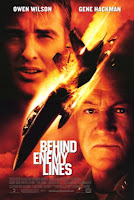
Day of the 'Dog: "Behind Enemy Lines"

Let me get right into why people think that today's 'dog - Behind Enemy Lines with Owen Wilson and Gene Hackman - is mediocre at best and horrific at worst. It isn't John Wayne's army, where heroes are hard, dedicated, iron clad men who would sooner cut out their hearts as bad mouth the US of A.

Face it: most war movies might as well have cast Sgt. Slaughter in the lead, draped in an American flag, a Coke in one hand and a machine gun in the other, a Marlboro cig hanging from below a handlebar mustache of ass-kickery. We don't like the idea that there are people in the military like Wilson's character, Lt. Burnett - reluctant, selfish men who aren't too keen on dying and like to question the efficacy of seemingly redundant missions during a seemingly redundant war (Bosnia).

I'm not dogging on The Duke - I'm up for a Wayne-a-thon as much as the next guy, but I can also appreciate a little flip side of war, and I don't mean violence. Plenty of war films ascribe to the idea that more gore must mean more truth - let's show 'em what war's really about by having some guy picking up his body parts and asking his sergeant "paper or plastic?" Dissension is an unpopular model for showing that other side, but is done exceptionally well in Lines. Not every solider has to be an ate-up Rambo type (despite pilots being notoriously that way).

Okay, so there must be some other reasons why Lines made Day of the 'Dog besides the clever back-talk of snarky Wilson. Well, consider this:

1. The cinematography is first-rate. Everything from shot angles to slow-mo to the use of color and shadow are just awesome. Lines is one of those movies I would be alright watching with the sound off, maybe having it in run on loop in the background like gangstas do Scarface.

2. Owen Wilson is great in this very atypical role. If you like Wilson in other leads, then you'd definitely like him in Lines.

3. The story isn't exactly deep, but it does present an oft-neglected facet of our recent war history - that of our Clinton-era involvement in Bosnia.

So while IMDb flamers have pondered whether Lines is the worst war movie ever, and the overall 6.1 score speaks to its generally poor reception, just remember that blind or unrealistic patriotism does not a good film make, nor the opposite a film not worth seeing.

So check out Lines and make your own mind up as you enjoy the smashing visuals, clever dialogue, and unique point-of-view. Realistic? Not so much. But an awesome ride with a novel conductor? You bet.

Thursday, March 19, 2009

Throwback Thursday: "When Harry Met Sally"

Just before writing this review is, indeed, the first time I've seen When Harry Met Sally, and the fact that most people say "Really!" to that statement is a testament to the 1989 film, today's throwback.

The movie opens with Harry and Sally as recent college grads, and I find Billy Crystal's character mildly annoying - the whole collegial nihilist thing incites eye rolls and groans (perhaps largely because I was a collegial nihilist at one point) or because I find Crystal quite annoying when he's really trying to be, which - for an actor - I guess is kind of a compliment.

However, the film is really about how the two of them grow as people, getting past all of the hopes, fears, and realities that we've all encountered in one form or another. And the movie portrays this growth without sap or a lack of believability. This is where it really begins to grow on me.

Plus, the timing, script, and camera work are really top-notch, with inventive interludes, and good dynamics between Harry and Sally's friends. It's pretty clear throughout that it is not a rushed film, but clever and well thought-out.

While the laughs are numerous, you also really grow to care about the cast, making When Harry Met Sally a rare romantic comedy that both sexes can enjoy equally.

Monday, March 16, 2009

Day of the 'Dog: "The League of Extraordinary Gentlemen"

Few are fence-sitters when it comes to steampunk action film The League of Extraordinary Gentlemen, with many claiming it is a great flick and even more claiming it is a weak attempt at a niche genre. But let's look at the facts here:

1. There's tons of action. I think there are more bullets flying in this flick than the Predator many-gun scene, and that's a lot of lead.

2. The interpretations of classic Victorian literary characters is inventive, and insightful, particularly how Dorian Grey is portrayed - an excellent twist on a classic figure that kinda makes sense.

3. Great special effects. While there are some continuity issues here (as with many comic book flicks) little can be said indicting the excellent use of CGI.

So, why is LXG under-appreciated? Well, while the characters have some depth, most are largely two-dimensional - again pretty typical of comic book film. Some movie-goers also have a hard time with the steampunk alternate world concept, and cars and solar-powered subs in the 1800s is a little more than they're willing to accept.

Perhaps some small mention of what innovation allowed technology to advance in that direction would have been appropriate early on.

However, LXG is a solid action film that's no more outlandish than your average shoot 'em up, and is appropriate and entertaining for a broad audience while having enough wink and nod period references to keep the interest of Victorians - history and literary buffs alike.

So I say ignore the mediocre 5.4 IMDb rating and give LXG a try. You might just find yourself pulled into the story enough to check out the graphic novel and the wealth of others like it - many of which are the contemporary crown jewels of the comic book industry.

Saturday, March 14, 2009

Six Classic Monster Images Hollywood Gets Dead Wrong, Part Six

Faeries

Somewhere in Ireland, there's an ever-shrinking population of faeries pissed as hell at the mollifying of their race.

Some might think that faeries don't even belong in a list about monsters, but that only reinforces how deeply erroneous our contemporary views of faeries has become. And the culprit: once again, it's Tinsel Town.

Since studios regurgitate Peter Pan movies every few years to milk a few more bucks out of it, the image of Tinker Bell resonates as iconic of faeries, and with her very own Disney mousterpiece out on DVD to siphon hard-earned dollars from parents everywhere, you can bet the cutesy image will remain indefinitely.

The faeries of folklore would likely tear one of "Tink's" wings off and giggle as she flew in circles back to Never-Neverland. Faeries of legend ranged in size from tiny (like Tinkerbell) to as large as humans. They were nearly always in hiding, but didn't mind luring a human to follow them only to ambush the human and act with violence and even deadly force.

Known for stealing babies and swapping them out with their own "changeling" faerie children, faeries of old ring more of alien abductors than fun-loving creatures covering everything with pixie-dust. William Butler Yeats wrote quite a bit about the faeries in his book Mythologies, revealing the Irish of his day maintained a polite and unobtrusive respect for the faeries, akin to how people in North Dakota view minorities.

If there's ever to be a faerie uprising, however, warm smiles and muffled giggles at how cute they are will likely result in as ass-whooping.

Friday, March 13, 2009

Six Classic Monster Images Hollywood Gets Dead Wrong, Part Five

Zombies

These hordes of the undead have enjoyed a twist and turn here and there in both movies and fiction, but the formula has remained relatively the same: the walking dead come back to life craving the flesh of the living without fear, emotion, or regret.

Sure, some movies have zombies reclaim some cognizance (a la Fido and Return of the Living Dead III), but by and large they are the legions of reanimated corpses unstoppable except by severe head trauma via bullet, axe, bat, or spike-shooting gun thingy (Land of the Dead).

Historically, however, zombies are strikingly dissimilar. In the realm of voodoo, zombies are resurrected much as slaves or servants of the person who brought them back. I suppose the slave-master could order his zombie to go around moaning "Braaaaaaains," but more likely has him mowing the lawn or doing the dishes.

In other, similarly old traditions, zombies are more like that creepy vomiting girl from The Sixth Sense - come back to life to seek vengeance for crimes committed against them in life, like starring in The OC.

The desire for brains in particular is a recent trend for pop-culture zombies as is the resurrection of the long-dead, which - in zombie lore - is a no-go: only the recent dead may rise again.

Historically, zombies may also simply be humans without a soul, an image revamped in the popular book series His Dark Materials as a person whose daemon is severed.

Tuesday, March 10, 2009

Six Classic Monster Images Hollywood Gets Dead Wrong, Part Two

Mummies

Made famous by Boris Karloff, the image of the mummy as wrapped in bandages with a virtual grab bag of super powers is more a sprucing up of a relatively boring monster than indicative of mummy legend.

After the first few times you see a mummy walking no faster than a zombie and moaning as he ambles slowly closer, you start to wonder: what the hell could he do to me?

So, shaped largely by the popular films such as The Mummy series starring otherwise gigless Brendan Frasier, modern mummy lore includes intangibility, flight, super strength, and pretty much the combined (albeit filched) power repertoire of Spiderman's transfigured foe, The Sandman.

In legend, however, mummies were not the stuff of horror, but a cultural belief in life after death. Largely amid the Ancient Egyptians, mummification had little do with things that go bump in the night, but was a means of burial that would keep important figures in tact for the afterlife, hence burying them with worldly riches as well as necessities, such as food.

Naturally, just as ghosts have long held a fear factor, cultures have tied mummy lore to the fear of the undead, but it was Hollywood who created the modern mummy and all his mysterious and ambiguous powers.

Monday, March 9, 2009

Six Classic Monster Images Hollywood Gets Dead Wrong, Part One

I'm out of town this week, so I thought I'd queue up a series for your reading pleasure in lieu of posting nothing. As always, thanks for reading, check out this week's hilarious series, and look for more movie reviews next week.

Six Classic Monster Images Hollywood Gets Dead Wrong

We like to think that our modern monsters are the collective, historical monsters of myth from thousands of years ago, but often our modern conception of monsters is about as accurate to history as the movie Troy is to the Trojan War. Hollywood has sold us our nightmares, and often because it was the best that special effects of the time could come up with.

1. Werewolves

With origins as far back as ancient Greece and largely in Europe thereafter, there's very little about the mythology of werewolves that's made it into contemporary conventional wisdom. Like many monsters, we can look to film for our current erroneous assumptions about these lovable lycanthropes.

First, the whole silver bullet thing is fairly new and perhaps as recent as film, since this "only one way to kill a werewolf" according to the portly Horace from The Monster Squad would have been rather inconvenient before the invention of gunpowder. Silver in general is harmful to them, but so is belladonna. But you never heard much about belladonna suppositories as a weapon.

Likely, silver just makes for better weapons, though according to ballistic theory, it would make a pretty crappy bullet because the soft metal would tumble, so you'd be better off with the suppositories.

Where legend has them hunting much like a wolf and not killing humans, in modern interpretations they'd pass up a deer any day for some fresh teenager.

The only cannibalistic tendencies lore has them committing is devouring the recent dead, which is a pretty good bargain if you'd ever have to pay for a funeral. Super-senses, superhuman strength, and a tendency to wig out at the full moon are in-line with some werewolf legends, but transmittal of the werewolf curse via a bite is less frequent than it being a hereditary condition or a laid-on curse.

Thursday, March 5, 2009

Throwback Thursday: "Night of the Comet"

Calling Night of the Comet a little bit '80s is like saying that Amy Winehouse is a little bit troubled or that Steve Carrel is a little bit funny.

While Comet is late '80s, it bears all the lovable tropes of your favorite '80s flicks. Foremost, it really reminded me of the sweet mini-series V. You have concepts that are extremely difficult to portray without a big budget, so you skirt around it a bit with lighting effects, cool sounds, and lots of stuff that happens off-screen. It really works, for the most part.

So a comet passes by leaving most everyone dead, leaving the partially protected insane zombies, and leaving the wholly protected (it seems metal is the magic material in this case) untouched. Though the sporadic zombies then become an obstacle to be reckoned with.

Notice I said "obstacle" not "force." There aren't too many of them, though they - too - are relegated to '80s garb and uber-cool accessories such as sunglasses worn in the dark and shiny cover-alls.

The story is okay, and the main characters are all likable if a little unrealistic in their acceptance of the circumstances.

Looking at a film purely by its ability to entertain, Comet is good stuff. It's well-paced, with some action, comedy, and cool era effects - especially for fans of circa '80s sci-fi. Don't look to it for another Armageddon or Deep Impact, but then again, how many of those do we really need anyway?

Wednesday, March 4, 2009

Nine Hollywood Tropes Moviegoers Loathe: Part Nine

Blackup

When the popular regard in mainstream movies toward blacks went from exclusion to sycophancy is unclear. Maybe once the general public collectively understood that black people existed outside of inner-cities and were bound for inclusion in every facet of everyday life (except in Montana).

Whatever the tipping point was, we now see the full-on effects of constant white-on-black ass kissery in film. Ironically, this has done nothing to dissolve racial stereotypes as the most common black prostration is having a black character act as a cool, hard, tough sidekick to the white protagonist.

Remember good ‘ole Paul Walker from 2 Fast, 2 Furious? There wasn’t a thing he could get into that his handy, black sidekick couldn’t get him out of. Dedicated, violent, loud, and shirtless, Tyrese Gibson was the quintessential blackup. If you missed this fine example, check out Death Race where Gibson plays the exact same character for Jason Statham.

Let’s not forget Police Academy, where simpering Steve Guttenberg had not one but two blackups. There was Larvell Jones (comic relief, moral support), and Hightower (just in case things got physical). Any call for blackup was immediately met with arbitrarily loud laughter in Jones’ case, mostly so that white moviegoers could show their colorblindness by respecting how hilarious every black person is, or the inevitable “whooooooaaaa” sound when Hightower stood full height whenever it was time to defend his homeboys (or when aforementioned color blindness was not displayed by less socially astute white people).

But let’s face it: blackup is no better than what Spike Lee called “The Magical Negro” in film. It’s not a tribute, and it really just reinforces moronic racial tropes of no real entertainment or practical value.

Wednesday, February 25, 2009

Day of the Doc: Confessions of a Superhero

I don't think that reviewing documentaries will necessarily become a weekly thing, but there are some excellent documentaries out there that are in no way so artsy that they would lose the mainstream moviegoer. Confessions of a Superhero is very much along those lines.

Confessions surrounds the lives of four actors who dress up as Superman, Batman, and Wonder Woman, and the Hulk and hang around in front of Mann's Chinese Theater posing in photos for tips. They make anywhere from $30 - $500 per day, so not exactly a predictable income, but potentially sweet.

Like many things LA, the characters have a sort of sad desperation about them, thinking that perhaps Steven Spielberg is going to come by and sweep them off of their rubber-booted feet with a lead role. They all have pretty spotty pasts, and mediocre futures, but they also take some pride in what they do, though I'm equally sure they'd rather be in some really, really bad movie rather than spend another minute in front of Mann's.

Confessions is very human in that it portrays many things about these four people that you can really relate to, not at all progressing like reality television, with slow piano music and slo-mo crying scenes backed with poorly-acted voice-over (if I had a nickel for every one of those).

Actually, it's exceptionally well cut - knitting together scenes that flesh out these people in a way that there own commentary or the insights of those actually shooting the doc never would. It's full of irony and truth, without making any spoon-fed judgments about how you're supposed to feel about them or about what they do.

I think that documentaries have come a long way in the last decade - shifting from something only emos and film school students cared for. Now, they are as well constructed and thought-out as any movie, and tend to come across far more germane because of it.

You don't have to have any interest in LA or super heroes to enjoy Confessions, just plan on doing something fun afterward, as this is ultimately a sad tale of failed dreams - an LA mainstay unfortunately.

Friday, February 20, 2009

DVD: RocknRolla lacks rock

While I am a huge fan of Lock, Stock, and Two Smoking Barrels and Snatch, Guy Ritchie's new-to-DVD and latest release RocknRolla falls short of my expectations.

The very cover of the DVD and the opening sequence of the film feature a promise of sex, violence and gun-play, with an image of a dual-wielding gunslinger looking like he belongs with the Tremor brothers from Smokin' Aces. Alas, this is just the drugged out, scrawny rocker who weighs a buck twenty and is about as intimidating as Seamus O'Grady from Charlie's Angels: Full Throttle.

While an action film needn't be violent for me to like it, when there's that expectation, and when there's not even a shot fired until more than an hour of the movie has passed, my expectations aren't being met.

Sure, there were some decent action sequences, often as flashbacks, but ultimately much of what is being built up - the clash between the Russians and the Brits, the accountant getting her comeuppance - all took place off-screen. While that's typical Ritchie, since Snatch is done in much the same fashion, in Rolla, it feels like it's just to move things alone or wrap up loose ends, not to better the film.

And lovable dad-type Tom Wilkinson, while a fine actor, doesn't hold a candle to the fearsome mob boss Brick Top from Snatch, just as - despite being a very likable character - Gerard Butler is no Turkish.

Perhaps it's not so much the lack of action that turned me off, but the combination of acting that feels a little rushed, like there weren't enough takes, too little direction, or simply hurried along. This comes through in several places that probably could have used one more pass on the editor's chopping block.

The music is excellent, as are many of the visuals, but Rolla otherwise disappoints and certainly doesn't live up to the very generous IMDb score of 7.4. Had I seen this in the theater based on that rating, I would have left quite unhappy.

Wednesday, February 18, 2009

Nine Hollywood Tropes Moviegoers Loathe: Part Eight

Bad Science

While the nature of my inside knowledge on explosives will remain classified, nothing ruins a scene more than seeing completely erroneous science occur by way of explosives - a staple of action movies. Perhaps the average Joe doesn’t care if a simple pineapple grenade somehow destroys an entire building, but for anyone with an understanding of physics, such sloppy science draws immediate ire.

May I direct your attention to Deep Blue Sea, which - while not exactly Jaws and not exactly a film I’d watch twice - sealed the deal with the final weapon against the uber-intelligent shark fiend about to escape into open ocean. Thomas Jane’s character - cheesily-named Carter Blake - opens two flares and tells inevitable survivor LL Cool J that they contain enough explosive to simulate a stick and a half of dynamite.

I’m sorry, what? If two flares contained enough bang to simulate more than a stick of dynamite, they’d be called dynamite. The latter contains a magical little chemical called nitro glycerin, where flares are made of the mighty phosphorus. Which is...um…not explosive.

The Specialist features a few WTF moments regarding elementary chemistry and physics. Notably at the end, when fat mob boss guy opens a locked the size of my friggin' pinky nail , screams, and then the camera cuts to just outside his house, where you see the whole wing blow up.

Umm, yeah, turns out that even C-4 can only do so much, and causing an explosion akin to a 500-pounder being dropped on a house might be a stretch for even the most scientifically disinclined to buy into.

In a similar fashion, despite being a sweet movie, Eagle Eye presents the same concept with an explosive gem that can magically destroy an area the size of a football field. Outside of a sci-fi novel, earth is governed by weird, immutably laws of physics involving gravity, friction, and the constrains of outward velocity when it comes to explosives.

I don’t pretend to know how it all works, but I can tell you how it doesn’t: the way it works in Hollywood.

Tuesday, February 10, 2009

Nine Hollywood Tropes Moviegoers Loathe: Part Seven

Disney Endings (modern day's Deus Ex Machina)

Who doesn’t like seeing the hero prevail after enduring 90 minutes of hardship? Of course we want Indiana Jones to get the girl and the treasure, or for Brewster to get the whole $300 million.

But that’s not what I’m talking about. I mean the kind of denouement that is nothing but a cheery end to a film that’s winding down and has to end sometime, so the directors just shoot the good guy winning and go have coffee.

Take Changing Lanes for example. It isn’t worth watching twice, but while watching it, I'm really growing concerned about where this feud between Ben Affleck and Samuel L. Jackson is going to end. Could it end up getting physical? Would one of them have to die?

Not to ruin a completely mediocre film, but what’s the magic cure for a brutal and ugly clash between these characters? A friggin' chit-chat! Affleck goes over to see Jackson’s wife - throwing out one of those cheesy side-grins of his - and he explains what’s happened.

Wow. How bloody exciting. A bit like the climax of 300 but…not.

How about the ladies’ favorite flick Pretty Woman? I can understand Gere’s character needing to go slumming: we’ve all been there. I can understand him defending her from the likes of George Costanza’s hairy mitts. I might even understand him learning to loosen up a little while this street-rat introduces him to more proletarian habits such as burping or the Arsenio Hall “whoo, whoo, whoo” thing.

But giving up the inevitable top-shelf ladies that a billionaire could pull for a prostitute? Umm…nahh. I'm not saying Hollywood needs to echo real life, or there'd be no Die Hard, but we at least need to feel like the ending wasn't just some slapdash scene hurried through because the studio was out of money.

Friday, February 6, 2009

Nine Hollywood Tropes Moviegoers Loathe: Part Six

Jewish jokes that nobody gets

I’m as PC as the next WASP, and sometimes I even mean it, but let’s talk demographics for just a sec. Jews make up 1 out of every 50 Americans: less than Mexicans, Blacks, and Asians. I think there are more Albino Yaks in America than there are Jews, and yet about half of all films come across like they premiered at a Bah Mitzvah.

I know the reasons: Jews make up a very significant portion of Hollywood producers, directors, and actors. I get it. But consider your target demographic here: someone from Anytown, USA with a little scratch and nothing better to do that go to a movie. I didn’t even know a Jew until I was like 25, and yet I feel like I know more about Jewish ritual and mores than an Orthodox Rabbi.

Take Bordello of Blood - a decent, inventive vampire flick that was a lot of fun. When they finally remove the heart from the head vampire, they have an arbitrarily long scene where Dennis Miller gets it disposed of a la some non-existent Jewish rite. Okay, we get it: your Jewish. You want an award? And there’s Miller clad in a yarmulke just in case you didn’t get the hint….psst, he’s Jewish! Forget the fact that it had dammit-all to do with the rest of the movie.

Now how about Adam I-can’t-make-one-joke-without-letting-you-know-I’m-Jewish Sandler. In Eight Crazy Nights you magically have a whole town in the heartland of America that just happens to be Jewish. Where the hell is that supposed to be? If I’ve met a Jew outside of New York or LA they were lost and wondering how to get back to the city.

I understand Sandler wants to hook all of his friends up with clever, Jewish inside jokes that the rest of us could give a hoot about, but a whole town?

Mel Brooks pulled it off with a little more subtlety at least, where you could watch his movies without knowing any Jews (which many of us don’t) and it could still be funny based on circumstance or delivery. Nowadays, though, I feel like I’m watching Curb Your Enthusiasm on loop.

Thursday, February 5, 2009

Throwback Thursday: "Three 'o' Clock High"

High school in the '80s was a cruel time of ill-advised fashion and what would today be social hara-kiri in the form of yellow sweater vest, bright aqua turtlenecks, and hair teased so high that it could tangle in low-hanging branches.

Three 'o' Clock High
is in many ways a very typical '80s movie: the main guy is dorky, but not too dorky, not like his friends; he has a brunette falling all over him, but he wants the blonde; and all matters high school are overblown to a global scale, as if the film's outcome holds the same weight as a war or a presidential election.

In many ways, though, High is anything but typical. From the very beginning, the camera work is extremely elaborate - shooting and editing must have been a bear. Sometimes this gives the impression of being overdone, but most times (particularly in the beginning montage) it adds solid appeal to a film that doesn't have much originality in the story or setting department.

The acting, with plenty of recognizable faces, is pretty good. While the story is predicated on an agreed-upon sense of drama quite typical of high school, everyone's on the same level, so there are no outliers to run against the film's grain.

The whole thing is supposed to be funny, I'm pretty sure, but it's not so much funny as it is comfortably entertaining. It would have been better with a few really solid laughs like how John Hughes would pepper his high school drama flicks, but High doesn't need the comedy to move it along, really.

So, though the story has been done before and since, give it a viewing for camera work and editing alone, both of which are excellent. In this way, High is a fine, under-the-radar addition to the Hughes-esque '80s canon.

Thursday, January 29, 2009

Throwback Thursday: "Omega Man"

I don't know what it is with Charlton Heston flicks lately, but this Thursday's throwback is Omega Man, inspired by my enjoyment of I Am Legend - the book and the movie.

Omega
follows Richard Matheson's novel about as much as Will Smith's I Am Legend, which means there are various interpretative liberties - some of which are good, some maybe not. For those who have seen or read Legend: in Omega, the "vampires" are more like albino Amish, with about as much of a fear factor.

The enemy of self-assured "last man on earth" Heston, the albinos refuse to use the machines of war to out Heston's character, Dr. Robert Neville. To me - this would have been a welcome handicap to accelerating their extinction, but Heston's Neville - much like Matheson's - mostly gets drunk and talks to himself.

Omega
also does a good job of portraying the book Neville's, ahem...yearnings, shall we say, that would be pretty substantial after a few years of no Internet porn.

The film is from 1971, and for the time period, they do a fine job of showing empty streets, isolation, mass death, and broad shots using clever camera tricks that we take for granted now that there's so much technology to facilitate it. Heston is a believable Neville if not a little creepy when he smiles.

This may be a childhood riddled with Planet of the Apes movies talking, but this felt eerily similar. While the albinos are a little off simian, I'd venture to guess that if you like Apes then you'll like Omega.

I strongly doubt there were any Oscars won for acting, but the period special effects are good, the story is pretty solid, and it's got some decent action sequences.

So, if you’re looking for another take on what World War Z author Max Brooks calls LMOEs (Last Man on Earth) type stories, which I favor, admittedly) then give Omega Man a go.

Wednesday, January 28, 2009